THE UNIFYING MEANING ARCHITECTURE MODEL

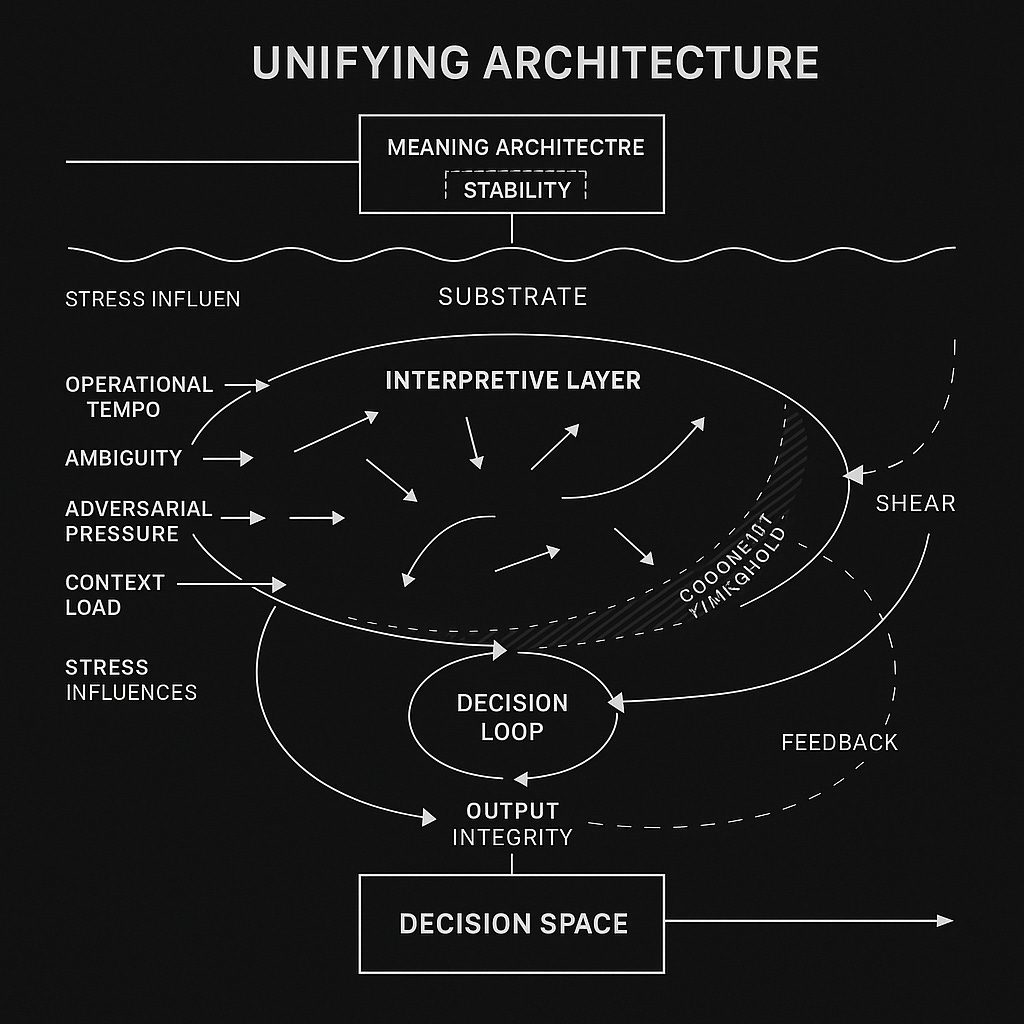
Purpose
The Unifying Meaning Architecture Model provides a single integrated view of how meaning is formed, stabilized, degraded, or collapsed across human–machine systems during high-tempo, ambiguous, or adversarial operations. It maps the substrate conditions, interpretive mechanisms, drift vectors, and operational stressors that collectively determine whether decision-making coherence is preserved or lost.
This model is not a metaphor.
It is a structural physics of cognition applied to AI-enabled environments.
1. Substrate Layer (Foundational Conditions)
The substrate represents the environmental, cultural, technical, and contextual conditions that shape all meaning-making before interpretation even begins. This includes:
operational context
organizational culture
data provenance
environmental noise
geopolitical framing
adversarial manipulation
tempo and mission load
Shifts in this substrate often precede observable interpretive problems - a phenomenon captured in the Substrate–Meaning Shear region.
2. Meaning Architecture (Constraint System)
Meaning Architecture functions as the scaffolding that stabilizes interpretation. It includes:
linguistic structure
symbolic associations
schema and mental models
doctrinal assumptions
shared operational vocabulary
trained interpretive habits
When meaning architecture is healthy, interpretations remain coherent under stress.
When it is brittle, interpretations drift even when information is technically correct.
3. Interpretive Layer (Cognitive Interface)
This is the layer where meaning is actually produced in real time - in humans, models, and hybrid teams.
It includes:
cognitive load
ambiguity tolerance
attentional bandwidth
sensemaking processes
model interpretability
operator mental framing
The interpretive layer is where drift vectors emerge - directional shifts in how signals are perceived relative to intended meaning.
4. Drift Physics (Directional Instability)
Drift is not randomness.
It has direction, velocity, and magnitude.
Drift Physics defines:
how interpretations move under pressure
where meaning collapses into noise
how subtle misalignments compound into operational failure
how adversaries exploit interpretive biases
It is the earliest detectable precursor to cognitive failure.
5. Meaning Stability Threshold (MST)
The MST is the boundary between manageable uncertainty and catastrophic interpretive collapse.
Above threshold → coherence persists
Below threshold → decisions lose alignment with ground truth
Crossing the MST is analogous to going “left-of-boom” in cognitive terms.
It is the most critical region in the entire model.
6. Cognitive Integrity Field
This field describes the health of the meaning-making ecosystem under load. It measures:
interpretive symmetry between humans and AI
coherence across teams
resilience to ambiguity
stability under adversarial pressure
Healthy cognitive integrity ensures that decision loops remain operationally trustworthy even when information is contested.
7. Decision Loop
This is where meaning becomes action.
The Decision Loop includes:
signal selection
prioritization
inference
plan generation
execution
If meaning collapses upstream, the decision loop becomes distorted even if the operator believes the system is functioning normally.
8. Output Integrity + Feedback
Downstream actions feed back into the substrate and alter future interpretation.
Poor output integrity accelerates drift - a positive feedback loop with catastrophic potential.
Clean feedback stabilizes all upstream layers.