Simulations & Digital Twins - Training for Chaos
Virtual War Rooms and Generative Battle Rehearsals

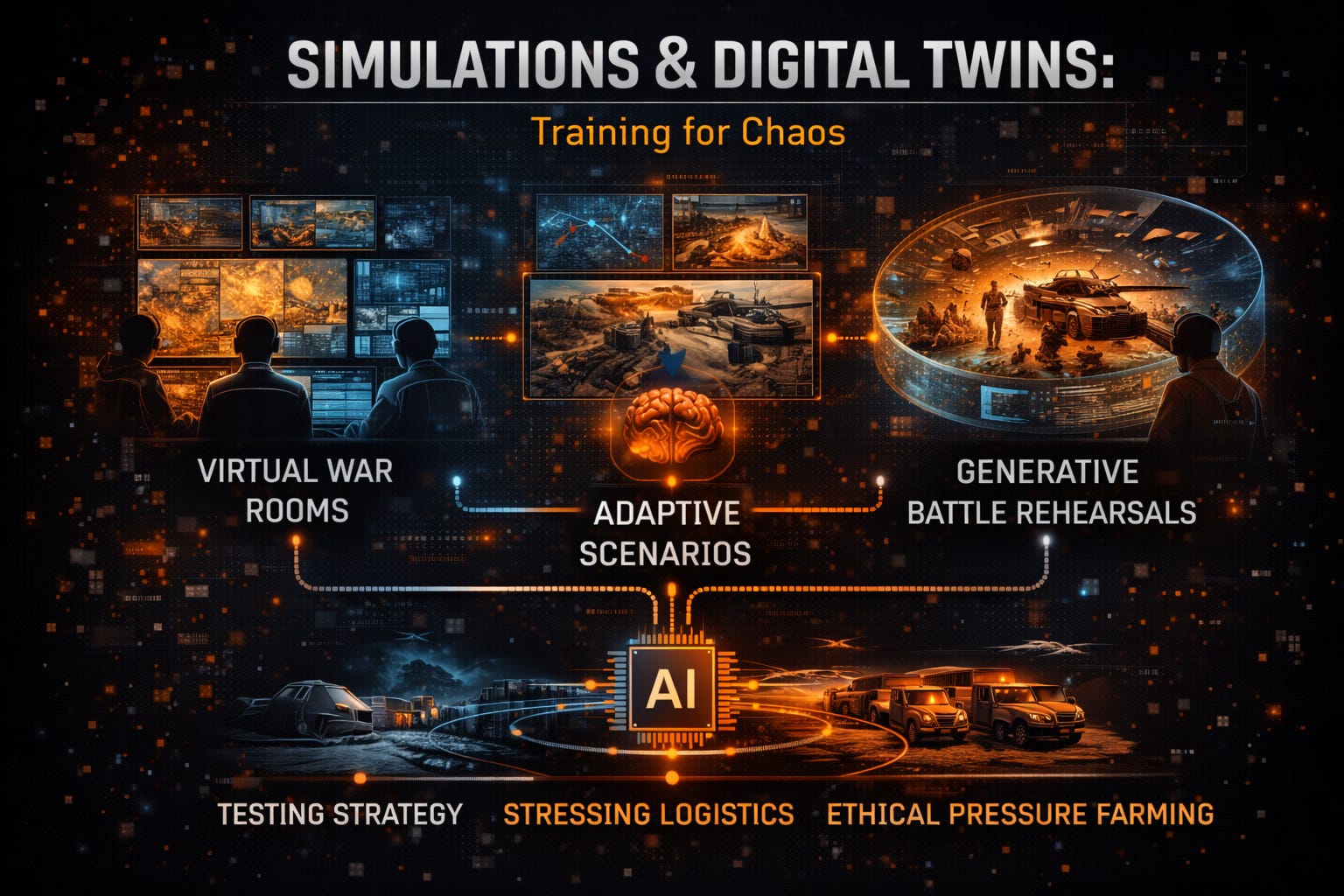
Executive Frame
Modern war is no longer rehearsed the way it is fought.
For centuries, militaries trained for conflict by drilling known scenarios, refining doctrine against historical patterns, and assuming tomorrow’s war would resemble yesterday’s - only faster, louder, and more destructive.
That assumption no longer holds.
Today’s conflicts are nonlinear, multi-domain, data-saturated, and adversarially adaptive. They unfold across physical, cyber, informational, and cognitive terrain simultaneously. They evolve mid-engagement. They punish rigidity.
In this environment, training for certainty is a liability.
What forces need now is not better prediction—but better preparation for surprise.
This is where simulations and digital twins enter the battlespace. Not as visualization tools. Not as procurement novelties. But as the backbone of a new training doctrine built around chaos, uncertainty, and decision stress.
The Limits of Traditional Training
Live exercises are expensive, slow, and constrained.
They rely on scripted injects, known objectives, and controlled escalation. Safety requirements cap risk. Logistics limit scale. Political optics shape outcomes.
These exercises are valuable—but incomplete.
They train coordination, not cognition.
They validate procedures, not adaptability.
They reward compliance with plan, not improvisation under collapse.
In short, they train forces to perform correctly - not to recover when correctness fails.
Modern conflict does not reward correctness.
It rewards resilience under ambiguity.
Simulation as a Cognitive Weapon
Simulations were once used to model systems.
Now they are used to stress minds.
AI-driven simulations can generate environments where:
Information is partial or contradictory
Sensors degrade without warning
Friendly systems fail mid-mission
Adversaries adapt in real time
Rules of engagement shift unexpectedly
These are not edge cases.
They are the norm.
Simulation becomes powerful when it stops answering questions and starts asking them.
Not “What happens if we do X?”
But “What do you do when nothing behaves as expected?”
Digital Twins: Living Mirrors of Reality
A digital twin is not a static model.
It is a continuously updated, data-fed representation of a real system - platform, unit, supply chain, or battlespace.
When connected to live data, digital twins allow commanders and planners to:
Test decisions before committing forces
Explore second- and third-order effects
Identify hidden dependencies
Observe failure propagation
This is not prediction.
It is rehearsal under evolving conditions.
A digital twin does not tell you what will happen.
It shows you what could break.
From Wargaming to Generative Rehearsal
Traditional wargaming relies on predefined scenarios and human adjudication.
Generative simulations change the paradigm.
Instead of replaying known threats, AI-driven systems generate adversaries that:
Learn from player behavior
Exploit doctrinal blind spots
Adapt tactics dynamically
Probe decision latency and coordination failures
Every run is different.
Every failure teaches something new.
This transforms training from memorization to exploration.
The goal is not to win the simulation.
It is to discover how you lose.
Virtual War Rooms and Decision Compression
Modern command environments are defined by speed.
Decisions must be made faster, with less information, and under greater political and ethical scrutiny.
Virtual war rooms powered by simulations allow leaders to practice this compression.
They simulate:
Conflicting intelligence reports
Time-delayed data feeds
Media and information pressure
Civilian presence and escalation risk
Leaders are forced to choose with incomplete clarity - and then live with the consequences.
This is the muscle memory that matters.
Training the Human–Machine Team
Future conflicts will not be fought by humans or machines alone.
They will be fought by ensembles.
Simulations allow teams to train not just tactics, but trust boundaries:
When to rely on AI recommendations
When to challenge them
When to override automation entirely
Digital twins expose how automation shapes perception.
They reveal how interface design influences judgment.
They surface how confidence scores can seduce decision-makers under stress.
Training without these insights is incomplete.
Chaos as a Feature, Not a Bug
Most training environments attempt to eliminate chaos.
Simulations should amplify it.
AI-driven systems can introduce:
Randomized failures
Adversarial deception
False positives and negatives
Unpredictable civilian behavior
This is not cruelty.
It is inoculation.
Units that have already failed in simulation fail less catastrophically in reality.
They recognize collapse faster.
They recover sooner.
The Risk of Synthetic Comfort
There is a danger.
Poorly designed simulations create synthetic confidence.
If models are too clean, adversaries too rational, and outcomes too explainable, training becomes self-deception.
Digital twins must be governed with the same skepticism applied to operational AI.
They must be:
Continuously validated against real-world data
Red-teamed aggressively
Designed to surprise their creators
A simulation that always makes sense is lying to you.
Logistics, Sustainment, and the Forgotten Variables
Simulations often focus on maneuver and fires.
The most valuable insights come from logistics collapse.
Digital twins that include:
Fuel consumption
Maintenance backlogs
Transportation disruption
Personnel fatigue
Reveal where plans quietly fail.
This is where wars are lost.
Training that ignores sustainment trains fantasy.
Strategic Advantages of Training for Chaos
Militaries that embrace simulation-driven rehearsal gain:
Faster adaptation during first contact
Lower cognitive shock under surprise
Better cross-domain coordination
More realistic assessments of readiness
They do not eliminate uncertainty.
They become fluent in it.
Ethics and Escalation in Synthetic Space
Simulations provide a rare opportunity to rehearse moral stress.
Leaders can confront:
Ambiguous targeting decisions
Civilian harm tradeoffs
Automation failure during lethal moments
Without real-world consequences.
This is not abstraction.
It is preparation for responsibility.
Final Thought
Future wars will not be won by forces that train for certainty.
They will be won by forces that are comfortable inside disorder.
Simulations and digital twins do not predict the future.
They prepare minds for when the future refuses to behave.
Training for chaos is not pessimism.
It is realism.
And realism is the most reliable advantage left on the modern battlefield.