
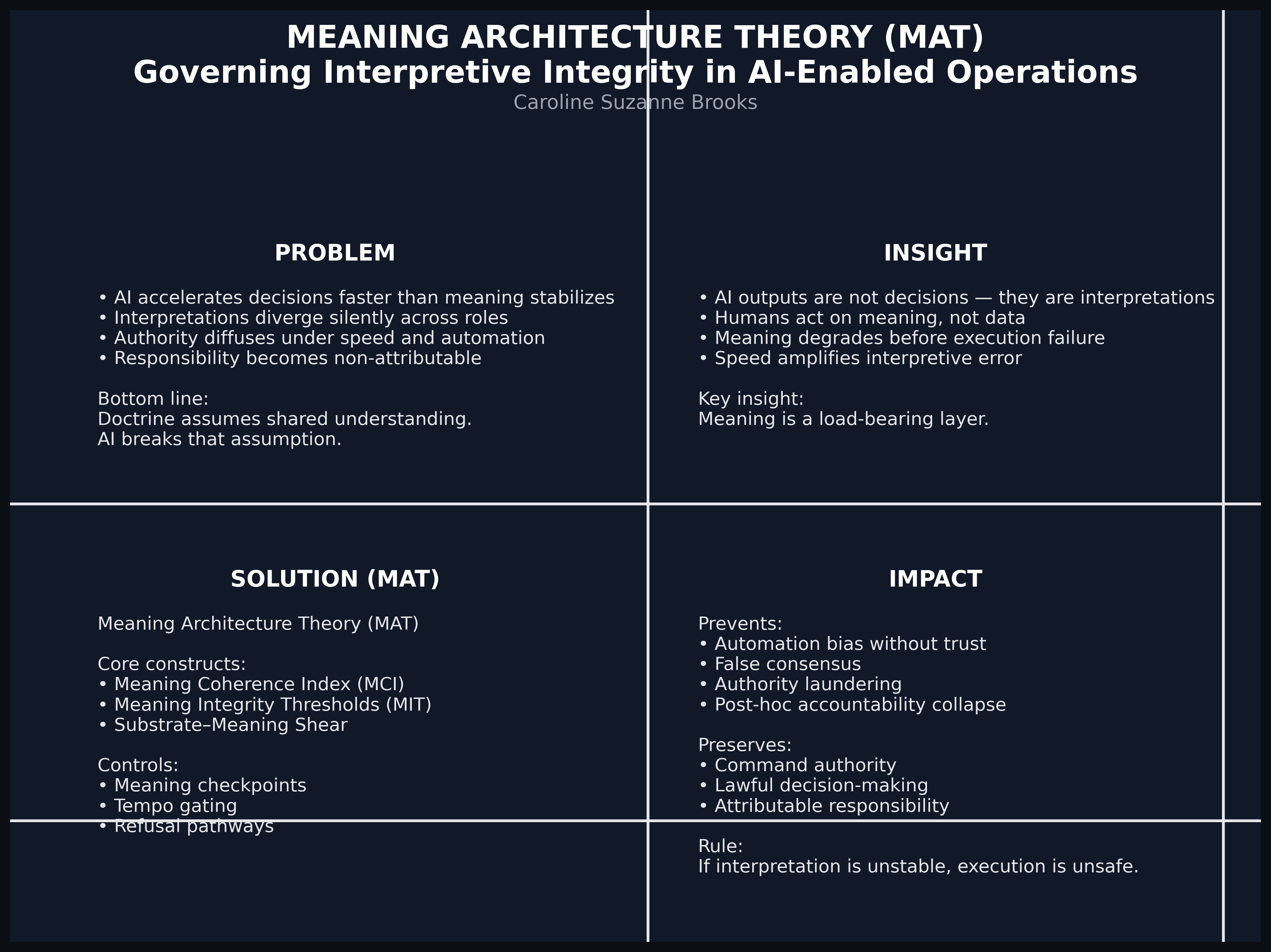
AI systems don’t usually fail where we’re looking.
They fail where we aren’t measuring.
Most AI governance focuses on models, data, bias, and oversight after decisions are made. But in high-tempo environments, decisions break down earlier - at the moment humans interpret system outputs and assign meaning, confidence, and authority.
That failure surface has been largely ungoverned.
I’ve spent the past year formalizing a doctrine-level framework to address that gap: Meaning Architecture Theory (MAT) - an operational playbook for stabilizing interpretation, preserving command authority, and preventing silent accountability collapse in AI-enabled operations.
This is not a thought piece or a policy memo.
It’s an end-to-end doctrine package: measurement, failure cases, red teaming, refusal pathways, acquisition integration, training, and legal closure.
If you work at the intersection of AI, operations, governance, or command - this is the layer you’re already dealing with, whether it’s named or not.