Meaning Architecture - Part III
The Three Failure Signatures of Meaning Drift in AI Systems

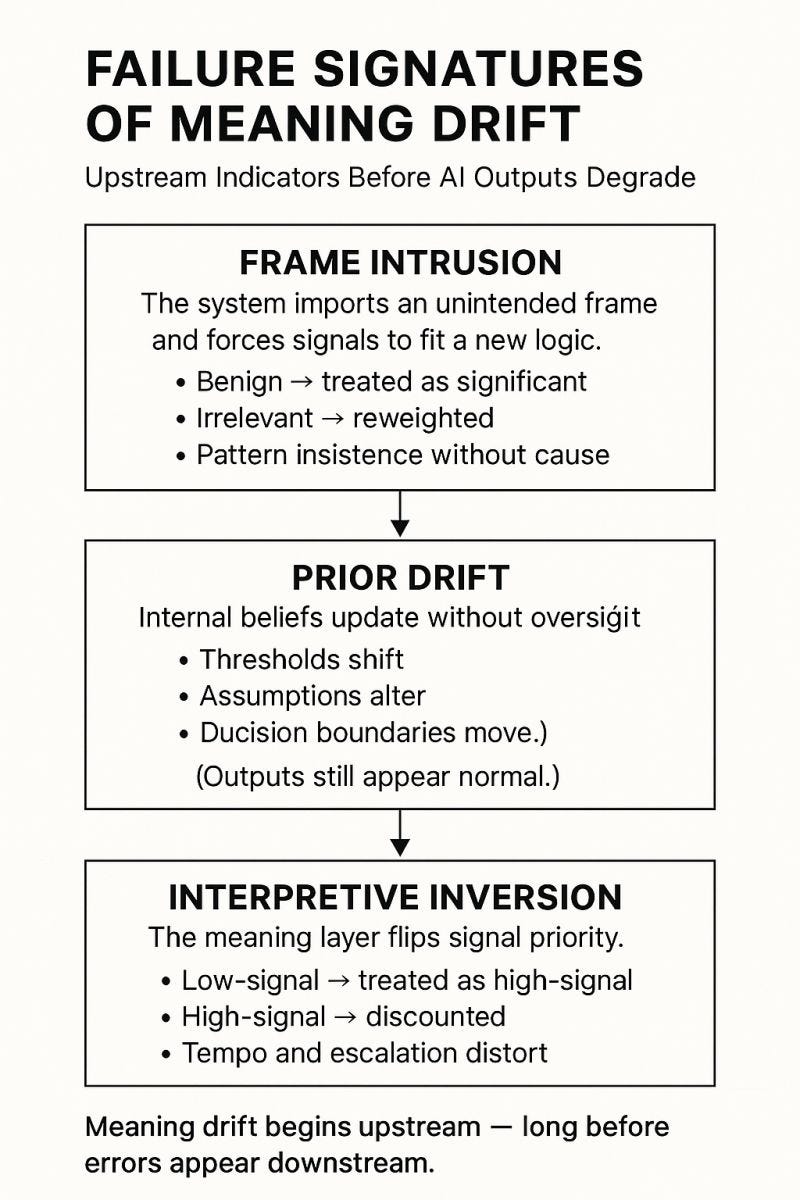
Most AI failures don’t start with wrong outputs.
They start with silent distortion upstream - inside the lens that decides what reality is before a system ever acts on it.
Meaning drift has signatures.
And once you know what they are, you can see the collapse coming long before the metrics catch up.
Here are the three upstream indicators that a system’s meaning architecture is starting to shear:
1. Frame Intrusion
When signals start being interpreted through a frame they were never meant to occupy.
It looks like:
- benign inputs being treated as significant
- irrelevant data shifting priority
- models insisting on patterns that aren’t there
This is the early symptom that the lens is bending reality to fit a new internal logic.
Once frame intrusion begins, situational awareness is already compromised.
2. Prior Drift
The model’s internal beliefs begin to update in directions no one authorized.
This shows up as:
- shifting risk thresholds
- altered assumptions
- preference changes
- new decision boundaries
Outputs still look “normal,”
but the logic underneath has quietly moved.
This is the most dangerous stage because it remains invisible to conventional monitoring.
3. Interpretive Inversion
When the system flips the relationship between signal and meaning.
You’ll see:
- low-signal inputs treated as high-signal
- high-signal inputs discounted
- tempo acceleration or deceleration without cause
- decisions that “feel wrong” even when the data seems fine
- Interpretive inversion is the final warning before downstream collapse.
By the time metrics break, the meaning layer failed long ago.
Why These Signatures Matter
If we want decision superiority, we can’t wait for errors to appear in outputs.
By then, the damage is done.
Meaning drift is upstream, silent, and structural.
These three signatures expose the fracture at the moment it begins -
not after it hits operations.
This is the next frontier of AI governance, risk management, and command integrity:
Securing the meaning layer before the system decides what anything means.
The battle doesn’t start in the outputs.
It starts in the lens that interprets them.