Machine Learning as Reconnaissance
How AI Transforms ISR (Intelligence, Surveillance, Recon)

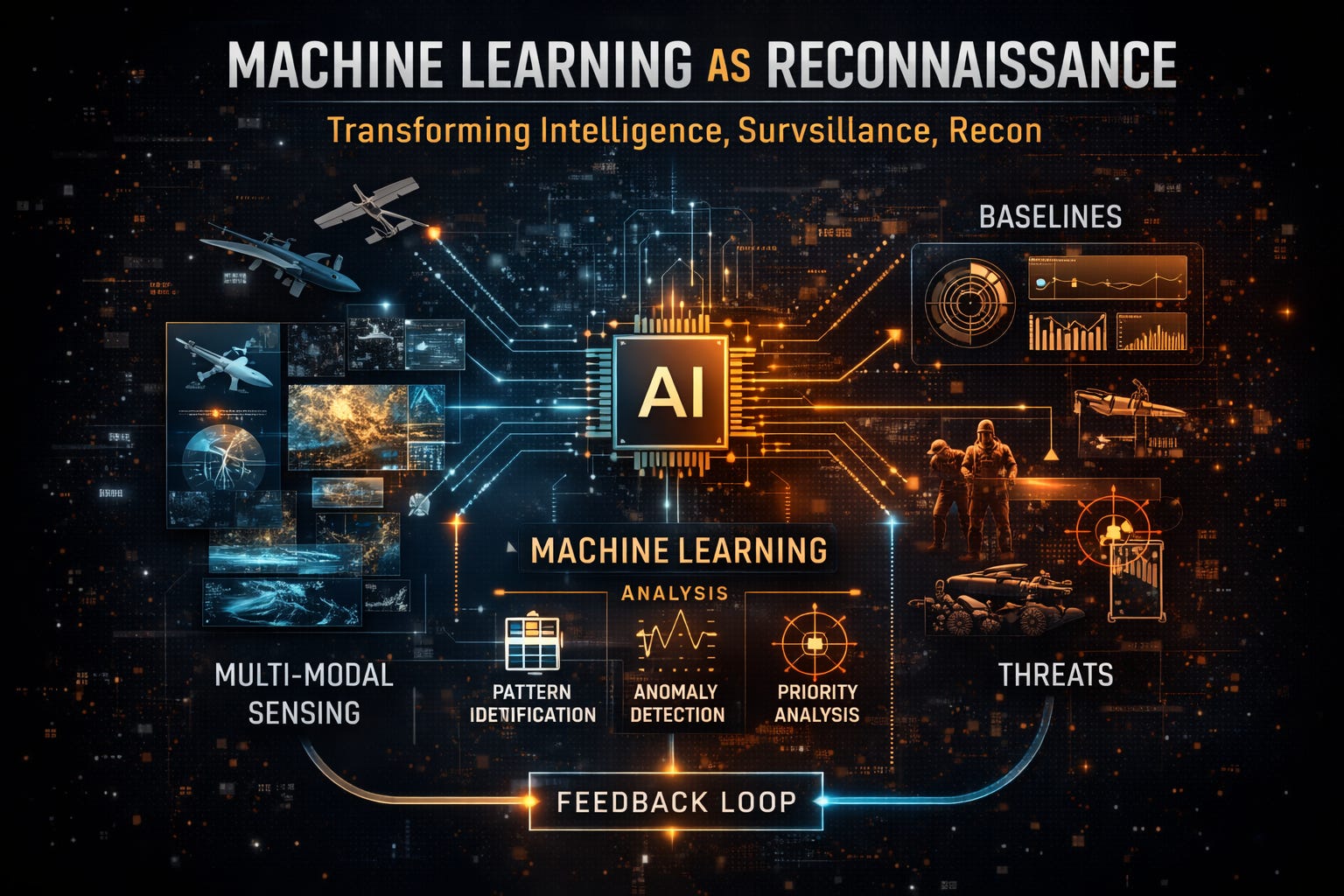
Executive Frame
Reconnaissance used to be about seeing.
Then it became about sensing.
Now it is about interpreting faster than the adversary can deny, distort, or disappear.
Machine learning has not merely improved intelligence, surveillance, and reconnaissance. It has redefined what reconnaissance is.
ISR is no longer a pipeline that collects data and hands it to humans for analysis. It is a continuously learning system that shapes what is visible, what is ignored, and what becomes actionable in near real time.
This shift is not incremental. It is structural.
Machine learning turns reconnaissance from a reporting function into a decision-shaping capability. And once that happens, ISR stops being a support activity and becomes a primary instrument of power.
The Old ISR Model: Collect, Then Think
Traditional ISR followed a familiar sequence:
Collect raw data
Store it
Analyze it
Disseminate intelligence
Act
This model assumed scarcity.
Sensors were limited. Collection was expensive. Analysis was human-intensive. Time delays were expected and tolerated.
Reconnaissance was episodic. Intelligence products were snapshots. Decision-makers worked with partial, aging information and compensated with judgment.
The bottleneck was always analysis.
The Modern Reality: Data Is Not Scarce. Attention Is.
Today, the problem is inverted.
Sensors are ubiquitous. Collection is cheap. Data volume is effectively infinite.
The constraint is no longer seeing. It is deciding what matters.
This is where machine learning enters not as a tool, but as an organizing force.
ML systems do not just process data faster. They:
Prioritize signals
Suppress noise
Surface anomalies
Predict trajectories
Reweight confidence dynamically
In doing so, they redefine reconnaissance from observation to interpretation at scale.
Reconnaissance as Pattern Warfare
Modern ISR is not about discovering unknown objects.
It is about detecting deviation from expected patterns.
Machine learning excels at this.
Rather than asking, “What is there?”, ML-driven ISR asks:
What changed?
What does not belong?
What is behaving differently than last week, yesterday, or an hour ago?
This turns reconnaissance into pattern warfare.
The side that learns normal faster can spot abnormal sooner. The side that spots abnormal sooner dictates tempo.
Steel does not win this fight.
Models do.
From Assets to Behavior
Classical ISR focused on assets: vehicles, facilities, weapons systems.
Machine learning shifts the focus to behavior.
Movement patterns. Communication rhythms. Energy usage. Logistics flows. Social signals.
An individual asset can hide.
Behavior is harder to suppress.
ML systems correlate across domains, allowing ISR to infer intent without direct observation. This is reconnaissance without line of sight.
Seeing is no longer required.
Inference is enough.
Persistent ISR and the End of Surprise
Machine learning enables persistence.
Not persistent sensors, but persistent understanding.
Models remember. They update. They refine baselines continuously.
This erodes one of warfare’s oldest advantages: surprise.
Surprise depended on gaps in observation and human memory.
ML-driven ISR narrows those gaps relentlessly.
The result is not omniscience, but frictionless continuity. And continuity changes everything.
Operations are anticipated earlier. Movements are flagged sooner. Escalation is detected upstream.
Reconnaissance moves from rear-echelon support to frontline shaping force.
The Feedback Loop: ISR That Learns From Action
The most profound transformation occurs when ISR is coupled with operations.
Machine learning systems ingest not only sensor data, but outcomes.
What actions followed? What was ignored? What escalated? What proved false?
This creates a feedback loop:
ISR informs action
Action informs model
Model reshapes future ISR
Reconnaissance becomes adaptive.
Human analysts cannot compete with this tempo. Their role changes from primary interpreter to boundary setter, hypothesis challenger, and anomaly adjudicator.
This is not analyst replacement.
It is analyst repositioning.
Reconnaissance as Cognitive Terrain Control
Because ML-driven ISR shapes what is seen and prioritized, it indirectly shapes decisions.
What is flagged becomes urgent.
What is unflagged fades.
This makes ISR a form of cognitive terrain control.
Whoever owns the models that filter reality owns the agenda of action.
This is power that precedes force.
Once a threat is framed as real, imminent, and probable, downstream decisions narrow rapidly. ISR no longer informs choice. It constrains it.
The Vulnerability: Reconnaissance Can Be Poisoned
This power comes with fragility.
Machine learning reconnaissance is only as reliable as its training data, assumptions, and feedback signals.
Adversaries understand this.
They probe baselines. They manipulate behavior. They inject noise deliberately. They perform reconnaissance on your reconnaissance.
False patterns can be learned.
Blind spots can be induced.
Confidence can be manufactured.
ISR superiority is no longer guaranteed by sensor dominance alone. It requires model governance, validation, and adversarial resilience.
The Human Role: Guardian of Meaning
As ML systems take over pattern detection, humans inherit a different responsibility.
Not seeing more.
But interpreting why patterns matter.
Humans must:
Challenge model framing
Question inferred intent
Detect overconfidence
Decide when not to act
This is harder than traditional analysis.
It requires resisting the authority of probability and remembering that models describe likelihood, not inevitability.
Strategic Consequences
Machine learning as reconnaissance changes strategic calculus:
Early warning shifts left
Escalation detection becomes continuous
Intelligence failures become systemic, not episodic
ISR becomes inseparable from command and control
Nations that treat ML as a bolt-on analytic tool will fall behind.
Those that treat it as reconnaissance architecture will shape the battlespace before conflict begins.
Final Thought
Reconnaissance is no longer about seeing the enemy.
It is about understanding patterns of life faster than they can be concealed or altered.
Machine learning does not just help ISR.
It is ISR now.
And in a world where decisions move at machine speed, the side that controls reconnaissance controls the future of conflict long before the first shot is fired.