Introducing the Meaning Stability Threshold (MST)

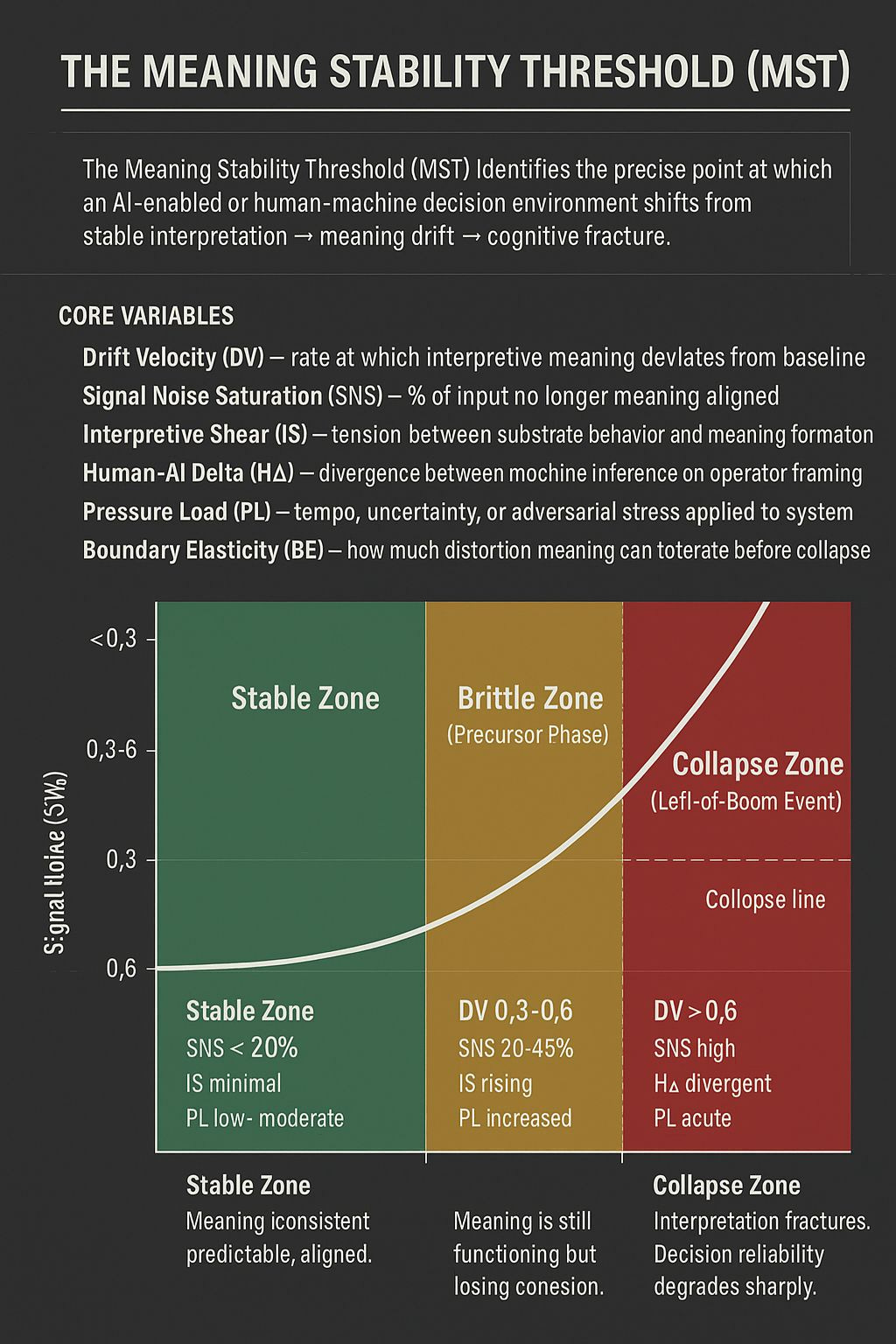
A left-of-boom indicator for cognitive integrity in AI-enabled operations.
We’ve mapped drift.
We’ve measured coherence.
We’ve built early-warning indicators.
But none of those matter without defining the tipping point -
the exact moment interpretation stops holding its shape.
That’s what the Meaning Stability Threshold (MST) captures.
Introducing the Meaning Stability Threshold (MST)
A left-of-boom indicator for cognitive integrity in AI-enabled operations.
We’ve mapped drift.
We’ve measured coherence.
We’ve built early-warning indicators.
But none of those matter without defining the tipping point -
the exact moment interpretation stops holding its shape.
When decision environments move from:
Stable interpretation → Meaning drift → Cognitive fracture.
The Variables That Determine Stability
- Drift Velocity (DV) – how fast meaning deviates from baseline
- Signal Noise Saturation (SNS) - % of input no longer meaning-aligned
- Interpretive Shear (IS) - tension between system behavior and human meaning formation
- Human–AI Delta (HΔ) - divergence between machine inference and operator framing
- Pressure Load (PL) - tempo, uncertainty, or adversarial stress
- Boundary Elasticity (BE) - how much distortion meaning can tolerate before collapse
The Threshold Model
Stable Zone
DV < 0.3
SNS < 20%
IS minimal
HΔ aligned
PL low–moderate
Meaning is consistent and predictable.
Brittle Zone (Precursor Phase)
DV 0.3–0.6
SNS 20–40%
IS rising
HΔ drifting
PL increased
Meaning still functions - but cohesion is slipping.
Collapse Zone (Left-of-Boom Event)
DV > 0.6
SNS > 40%
IS high
HΔ divergent
PL acute
Interpretation fractures. Decision reliability drops sharply.
Deliverable: The MST Threshold Chart
A three-band operational meter showing where meaning holds, where it destabilizes, and where it breaks.
This gives doctrine developers, commanders, cyber teams, and risk leaders something they’ve never had before:
A quantifiable stability line for the meaning layer of operations.