Introducing the Meaning Drift Forecast (MDF)A Predictive Tool for Left-of-Boom Cognitive Stability

Most organizations can detect when meaning collapses.
Some can measure it.
But almost no one can predict it.
Across every high-tempo environment I’ve analyzed - joint operations, fusion cells, AI-enabled decision loops - one truth keeps surfacing:
- Interpretation doesn’t break randomly.
- It breaks along a forecastable trajectory.
And once you can see the trajectory, you can stabilize it.
Today I’m sharing the third tool in the Meaning Integrity framework:
THE MEANING DRIFT FORECAST (MDF)
A predictive model for estimating how close a system, team, or mission is to interpretive failure under stress.
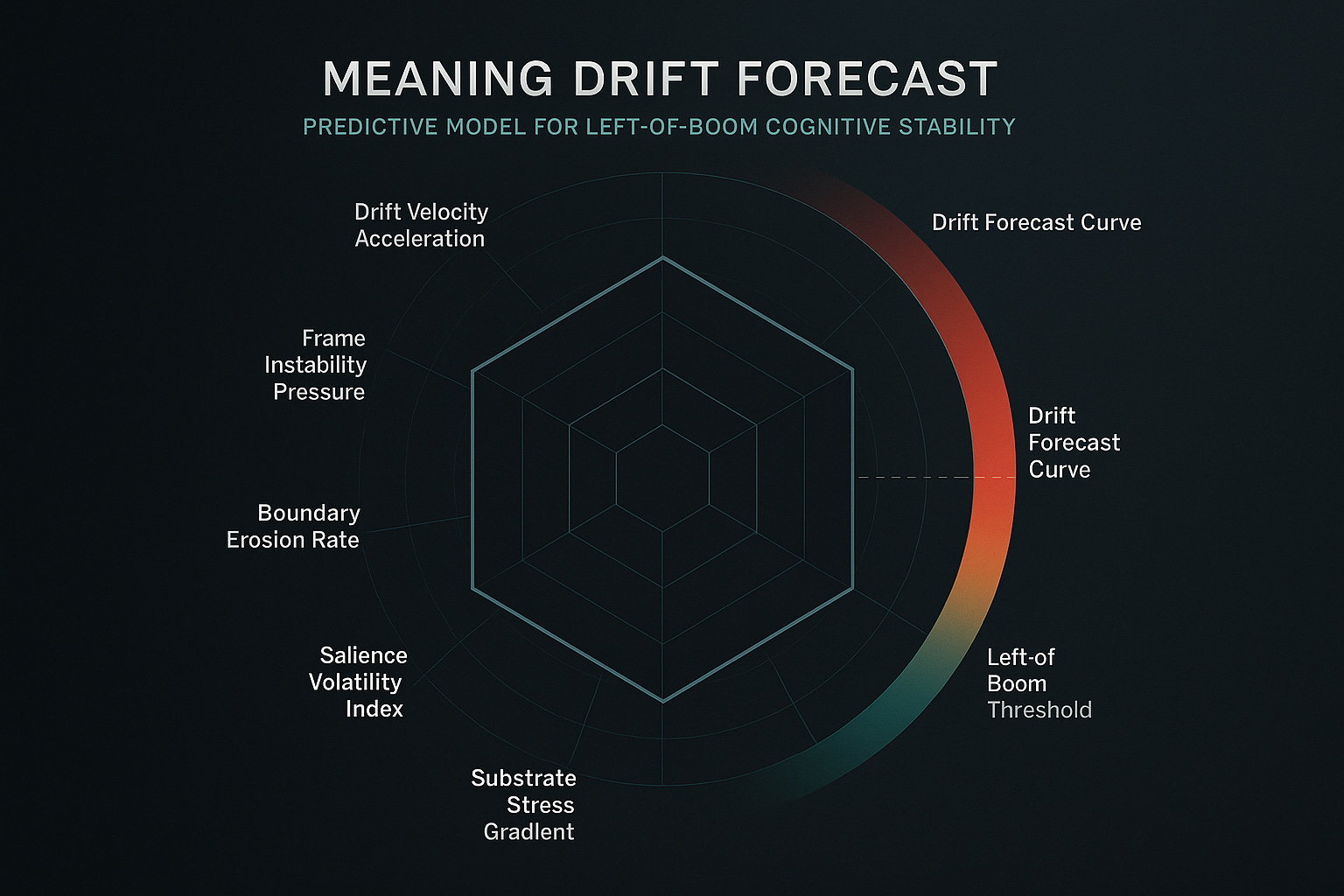
The MDF generates a Left-of-Boom risk curve using six leading indicators:
- Drift Velocity Acceleration
- Frame Instability Pressure
- Boundary Erosion Rate
- Loop Desynchronization Trendline
- Salience Volatility Index
- Substrate Stress Gradient
Each factor contributes to a consolidated Drift Forecast Curve - a visual predictor of when meaning will shear if tempo, pressure, or adversarial conditions intensify.
Why This Matters for Operations & Doctrine
The MDF gives planners and operators something they’ve never had:
A forward view of meaning stability.
Before:
- battle rhythms fracture
- ISR interpretation diverges
- teams lose coherence
- AI-human loops desync
- decision cycles turn brittle
This allows:
- earlier stabilization
- better wargaming
- proactive risk control
- improved joint training injects
- more resilient human–machine teaming
Meaning integrity isn’t just something we defend.
It’s something we can forecast.
If your team works in joint planning, doctrine development, wargaming, human–machine teaming, or AI operations, I’m happy to walk through the full model.
We’re building the cognitive battlespace toolkit one layer at a time.