Introducing the Meaning Coherence Index (MCI)A Left-of-Boom assessment for Joint Operations

We’ve got checklists for everything - fires, comms, cyber, logistics, force protection, even AI model performance.
But we still don’t measure the one variable that determines whether any of it holds under pressure:
Meaning Stability.
Across every joint exercise and AI-enabled operation I’ve studied, the same thing shows up:
systems don’t fail first - interpretation does.
And it drops below threshold long before anyone notices.
So here’s the tool built for doctrine developers, training architects, and planners:
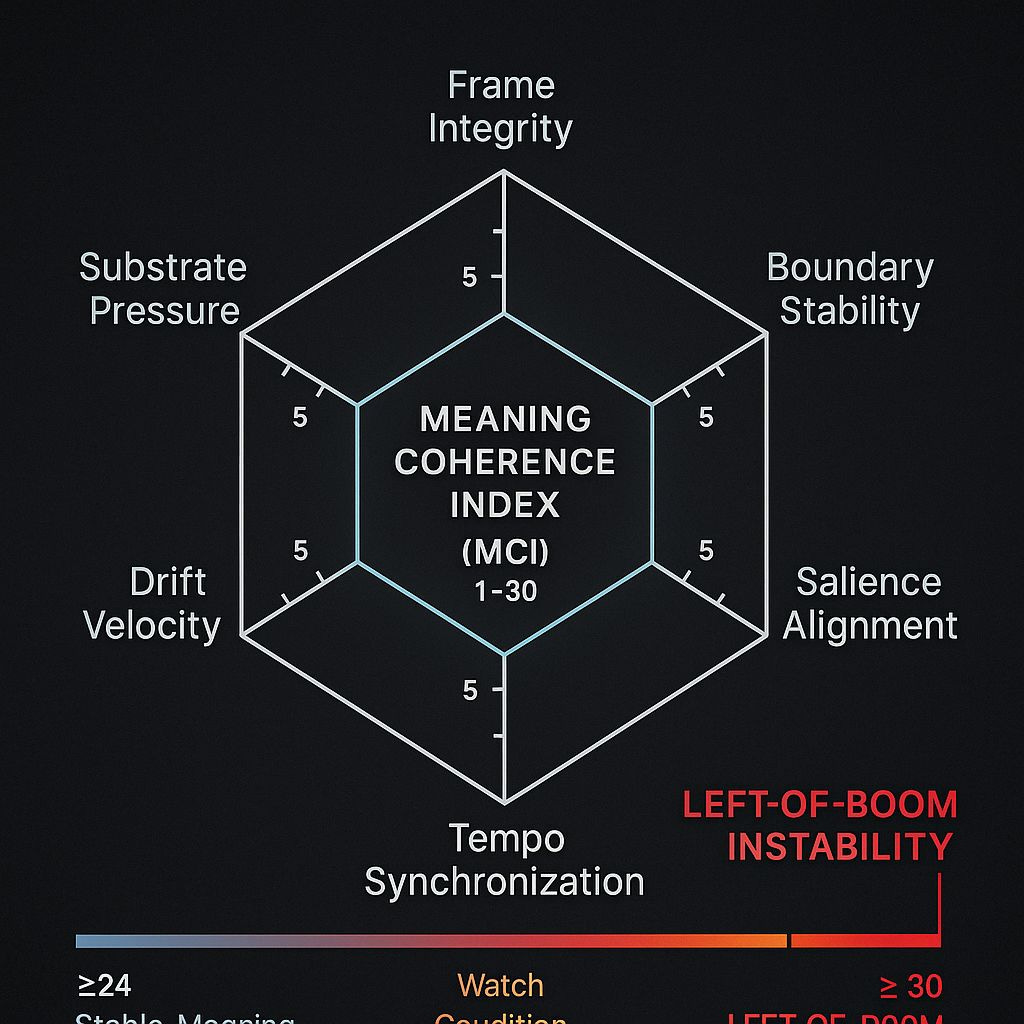
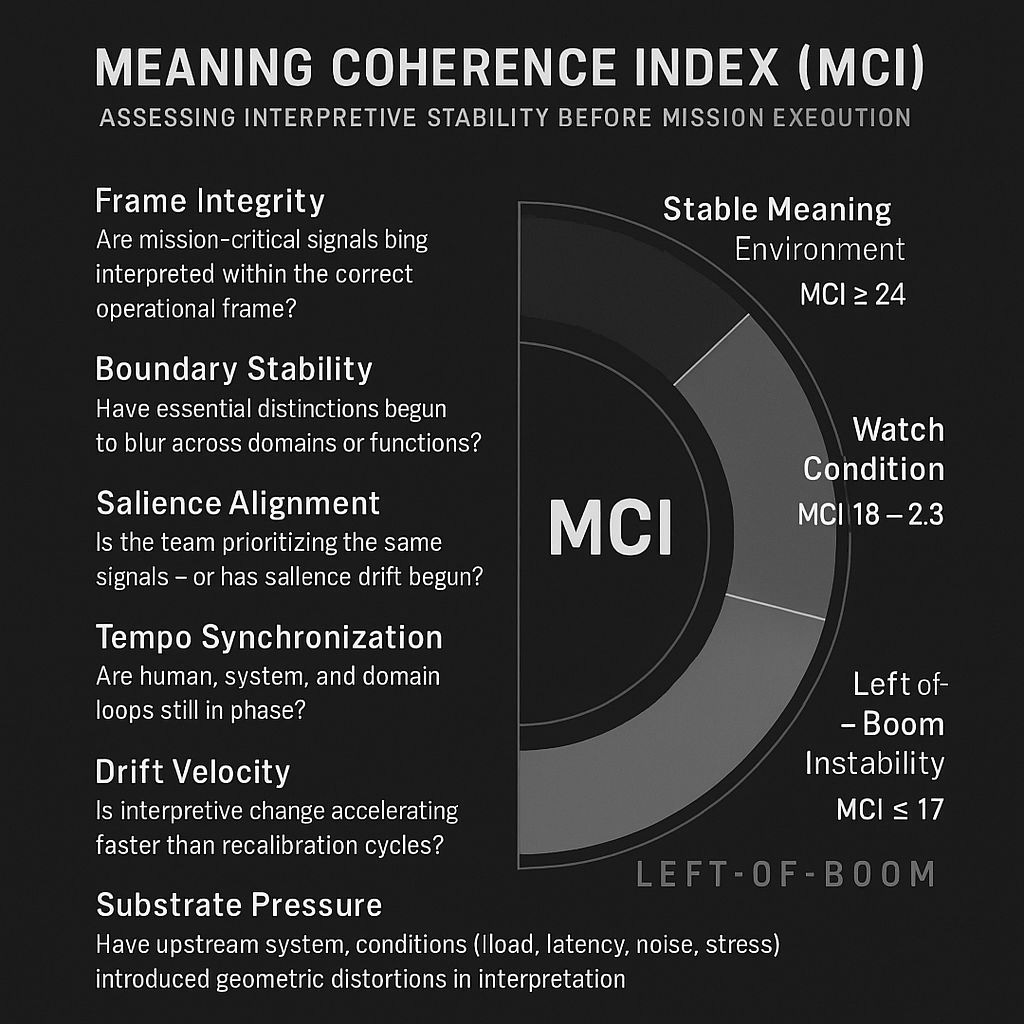
THE MEANING COHERENCE INDEX (MCI)
A rapid, doctrine-aligned way to gauge interpretive stability before execution.
It evaluates six factors:
- Frame Integrity - Are signals being read inside the correct frame?
- Boundary Stability - Are distinctions starting to blur?
- Salience Alignment - Is the team prioritizing the same signals?
- Tempo Synchronization - Are human/system loops still in phase?
- Drift Velocity - Is interpretive drift accelerating?
- Substrate Pressure - Are upstream system conditions distorting meaning?
Scoring (1–5 each):
24+ → Stable (Coherence holds)
18–23 → Watch (Drift emerging)
17 or below → Left-of-Boom Instability
WHY THIS MATTERS
Meaning stability is the prerequisite for operational coherence.
If interpretation shears, everything downstream fractures:
- battle rhythm
- ISR alignment
- targeting cycles
- AI decision loops
- cross-domain coordination
- commander’s intent
- tempo
The MCI gives the Joint Force a way to:
- detect drift early
- fold meaning stability into mission analysis
- tie it to CCIR and risk frameworks
- use it in wargaming and rehearsal
- stabilize Left-of-Boom conditions before execution
We’ve never measured this layer - and it’s the one operations depend on the most.
If your team is working doctrine, training, or human–machine teaming, I’m glad to share the full framework.
Meaning is now as critical as maneuver. Time to measure it.