Introducing the Cognitive Load Collapse Predictor (CLCP)

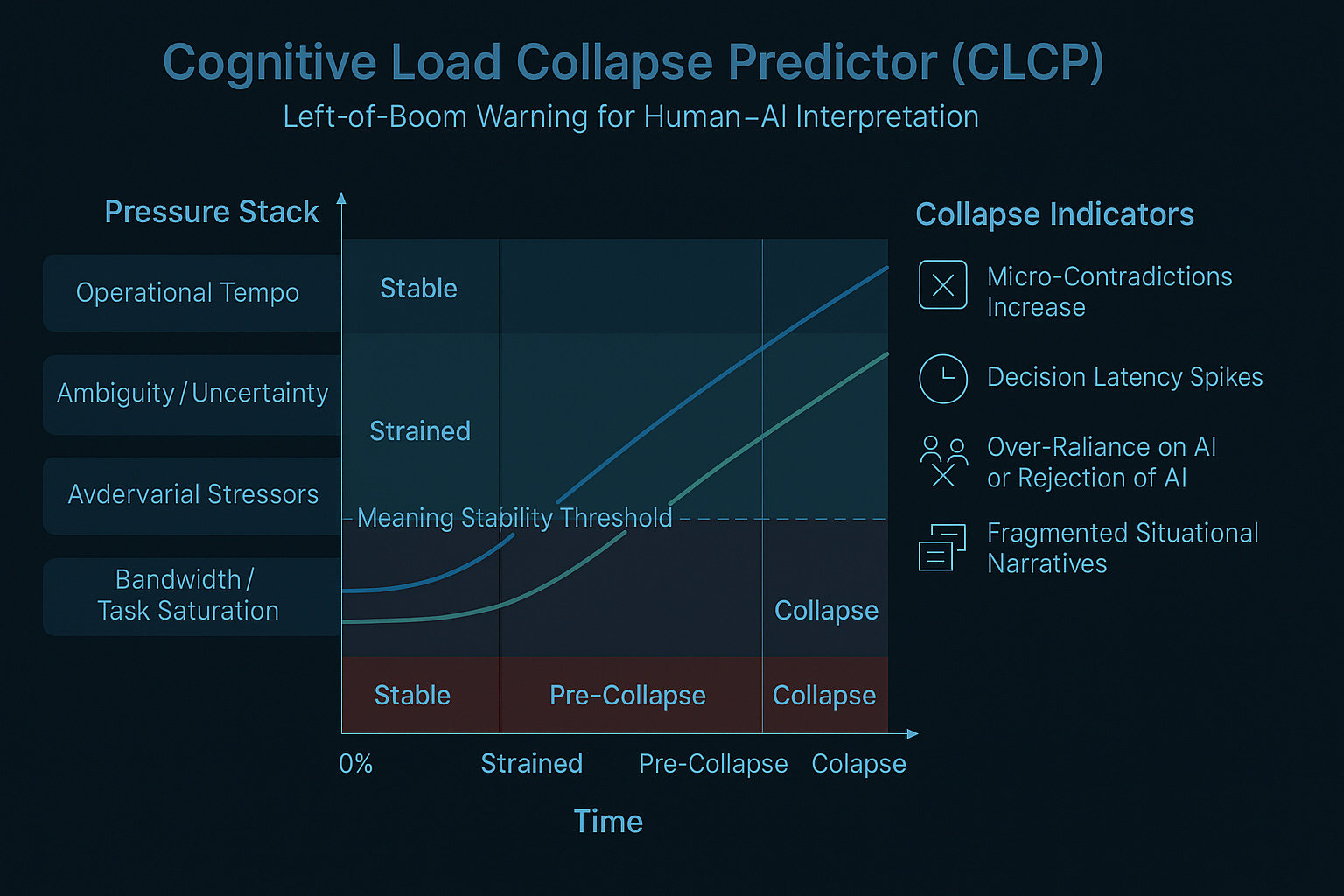
We treat cognitive overload like weather:
uncomfortable, but survivable.
But across every exercise and AI-enabled mission I’ve studied, the pattern is the same:
Operational failure doesn’t start when people feel stressed.
It starts when humans and machines lose the ability to hold a stable interpretation under pressure.
That’s collapse.
So I built a tool for that moment.
The Cognitive Load Collapse Predictor (CLCP) is a left-of-boom model for the cognitive battlespace. It tracks four pressure stacks:
• operational tempo
• ambiguity and uncertainty
• adversarial stressors
• bandwidth and task saturation
and maps them against a single variable that really matters:
Interpretive Integrity.
On the CLCP map, you see three curves over time:
– human cognitive load
– AI drift index
– the Meaning Stability Threshold (MST)
When human and machine trajectories both bend toward that threshold while pressure spikes, you’re no longer in “stress management.”
You’re in a pre-collapse window.
This is the gap between “everyone feels busy” and
“the frame just broke and nobody noticed yet.”
We’ve had tools to monitor fires, comms, cyber, logistics.
CLCP is a tool to monitor something more fragile:
whether anyone can still see the battlespace clearly enough to make a coherent decision.
If interpretation is now a center of gravity,
we need left-of-boom warning for when it’s about to fail.