Interpretive Integrity: The New Center of Gravity in Modern Conflict

The last decade of warfare taught the U.S. something uncomfortable:
it doesn’t matter how perfect your operating picture is if the people reading it don’t interpret it the same way.
We keep trying to fix decision-making with more sensors, more data, more fusion, more automation - but the failure point isn’t downstream.
It’s upstream.
It’s the interpretive layer.
1. The Real Decisive Point Isn’t Information - It’s Coherence
Command doesn’t collapse because people disobey.
Command collapses when people interpret differently.
When two operators look at the same data and draw incompatible conclusions, you no longer have a unified force - you have parallel realities whose divergence won’t show up in any dashboard.
That drift is invisible until it breaks something.
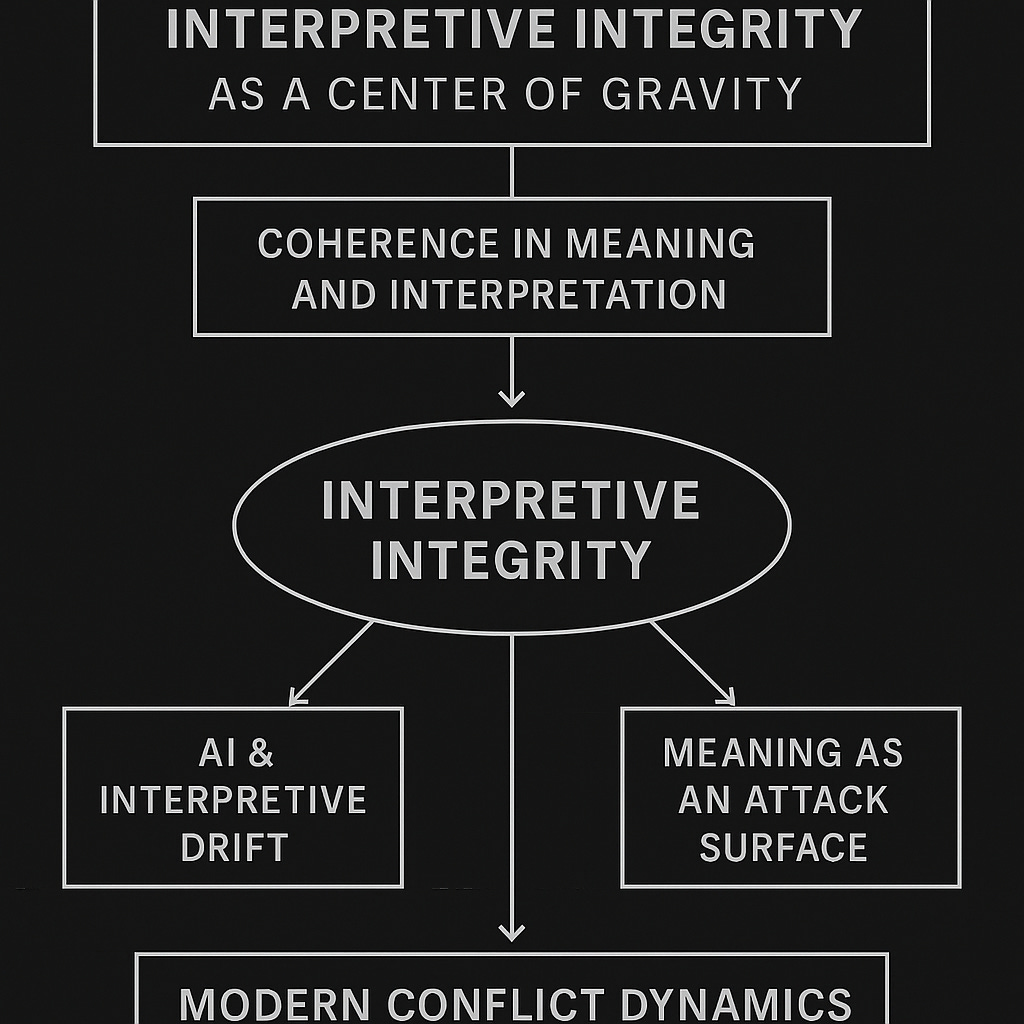
Interpretive integrity - the ability of humans and machines to maintain shared meaning under pressure - is now the center of gravity in modern conflict.
Nothing downstream survives without it.
2. AI Accelerates Interpretation Drift
AI doesn’t just alter workflow.
It alters sensemaking architecture.
Once a machine is performing the first pass of interpretation, the human is no longer receiving raw reality - they’re receiving pre-structured meaning.
If the system and the human don’t share the same interpretive model, you get:
mismatched threat assessments
divergent situational awareness
incoherent recommendations
contradictory decision loops
fractured command intent
This is the failure mode we don’t measure.
We don’t brief it.
We don’t train for it.
We don’t protect against it.
But adversaries exploit it constantly.
3. The New Attack Surface Is Meaning
You don’t need to corrupt systems to break a mission.
You only need to corrupt how a system’s output is interpreted.
That’s the new attack surface:
frame bending
narrative anchoring
perception saturation
ambiguity engineering
machine-human divergence
interpretive overload
These are not cyber threats.
These are cognitive threats.
And the Joint Force has no doctrinal backbone for them.
4. You Can’t Achieve Decision Superiority Without Interpretive Stability
Every modernization effort is aimed at speed:
faster fusion, faster analysis, faster targeting.
But speed is worthless when interpretation fractures.
Decision superiority is not about velocity.
It’s about alignment.
And alignment is impossible without interpretive integrity.
This is the missing upstream condition for every modernization effort currently underway.
5. Interpretive Integrity Must Become a Measured, Defended, and Commanded Asset
If the Joint Force wants to operate in a coherent cognitive battlespace, it needs to:
1. Define the interpretive layer
What it is, how it behaves, and where it fails.
2. Develop indicators of interpretive drift
Human-machine divergence, ambiguity accumulation, frame splitting.
3. Build architectures that preserve meaning across domains and echelons
4. Train for the cognitive seams of modern operations
Not just the technical seams.
5. Treat meaning as a strategic terrain
Something to defend, not something to assume.
Interpretive integrity is not a “soft skill.”
It is the decisive factor in whether a joint force can fight as one mind.
If we fail here, nothing downstream will matter.
The Bottom Line
The future fight isn’t won by who sees fastest.
It’s won by who interprets together long enough to act decisively.
Interpretive integrity is not a buzzword.
It’s the new center of gravity.
It’s the upstream vulnerability driving downstream chaos.
And it’s the doctrinal gap we have to close - now.