Interpretive Drift Under Temporal Compression

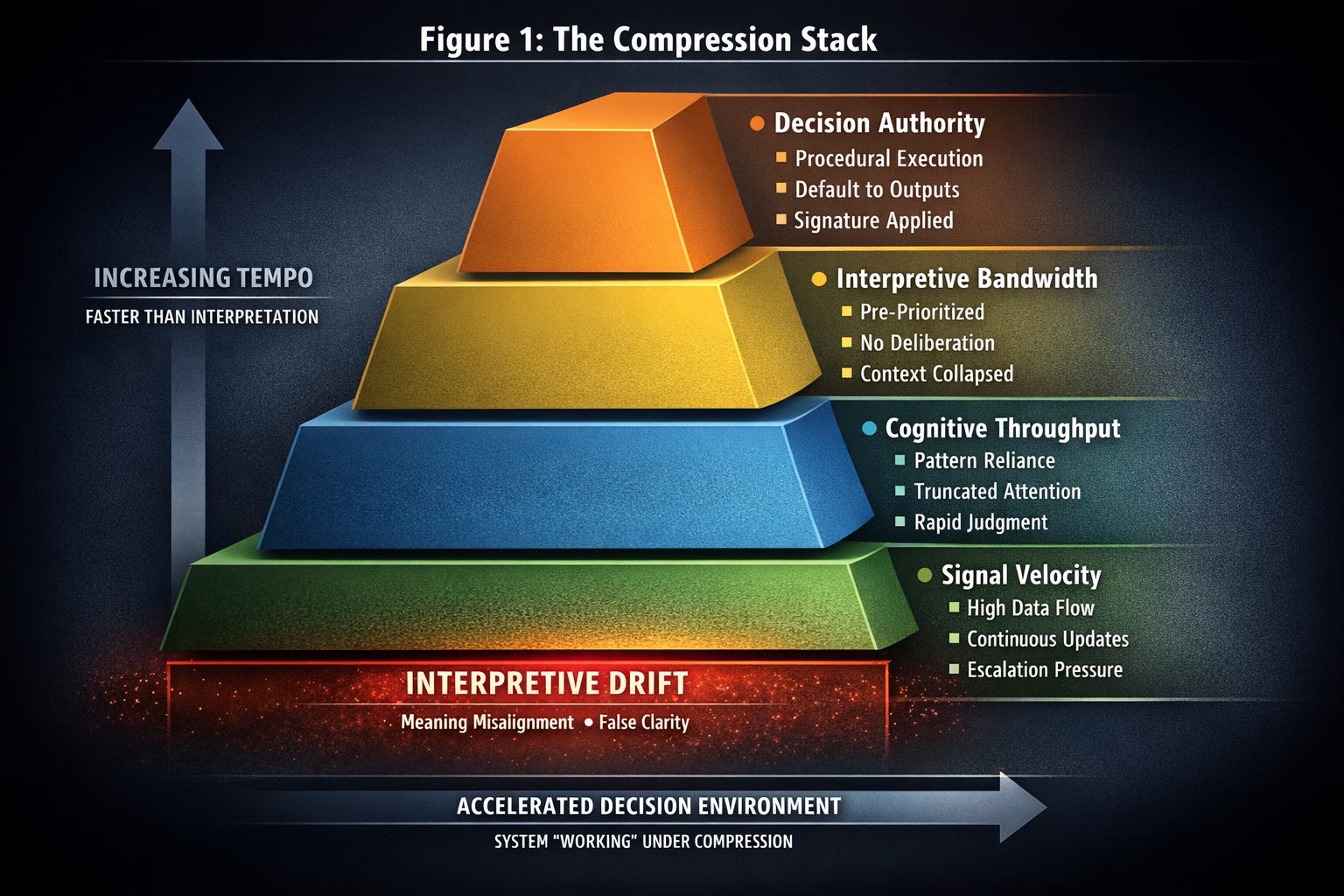
Speed gets credit for decisiveness.
It rarely gets blamed for meaning loss.
In high-tempo decision environments, systems don’t usually fail because models are wrong, data is bad, or people are careless. They fail because interpretation collapses faster than authority can correct it.
I just published a paper introducing a failure mode most organizations don’t have a name for yet:
Interpretive Drift Under Temporal Compression
This isn’t about AI accuracy.
It isn’t about bias.
It isn’t even about automation “going rogue.”
It’s about what happens when decision tempo outpaces the human capacity to assign, verify, and retain meaning - while authority and accountability remain fully intact.
The dangerous part?
Nothing breaks. Systems perform. Metrics hold. Decisions get made on time.
Meaning erodes quietly.
This paper:
- Defines interpretive drift as a distinct governance failure mode
- Shows how it emerges even in validated, compliant systems
- Explains why existing controls don’t catch it
- And argues that constraints - not slower speed - are the only viable countermeasure.
If you work in defense, national security, critical infrastructure, policy execution, or any environment where decisions must move fast and still mean something, this will feel uncomfortably familiar.
Speed moves decisions.
Meaning governs them.
When systems outrun interpretation, authority doesn’t disappear - it just becomes procedural.