Human–AI Coherence Synchronization Index (HACSI)

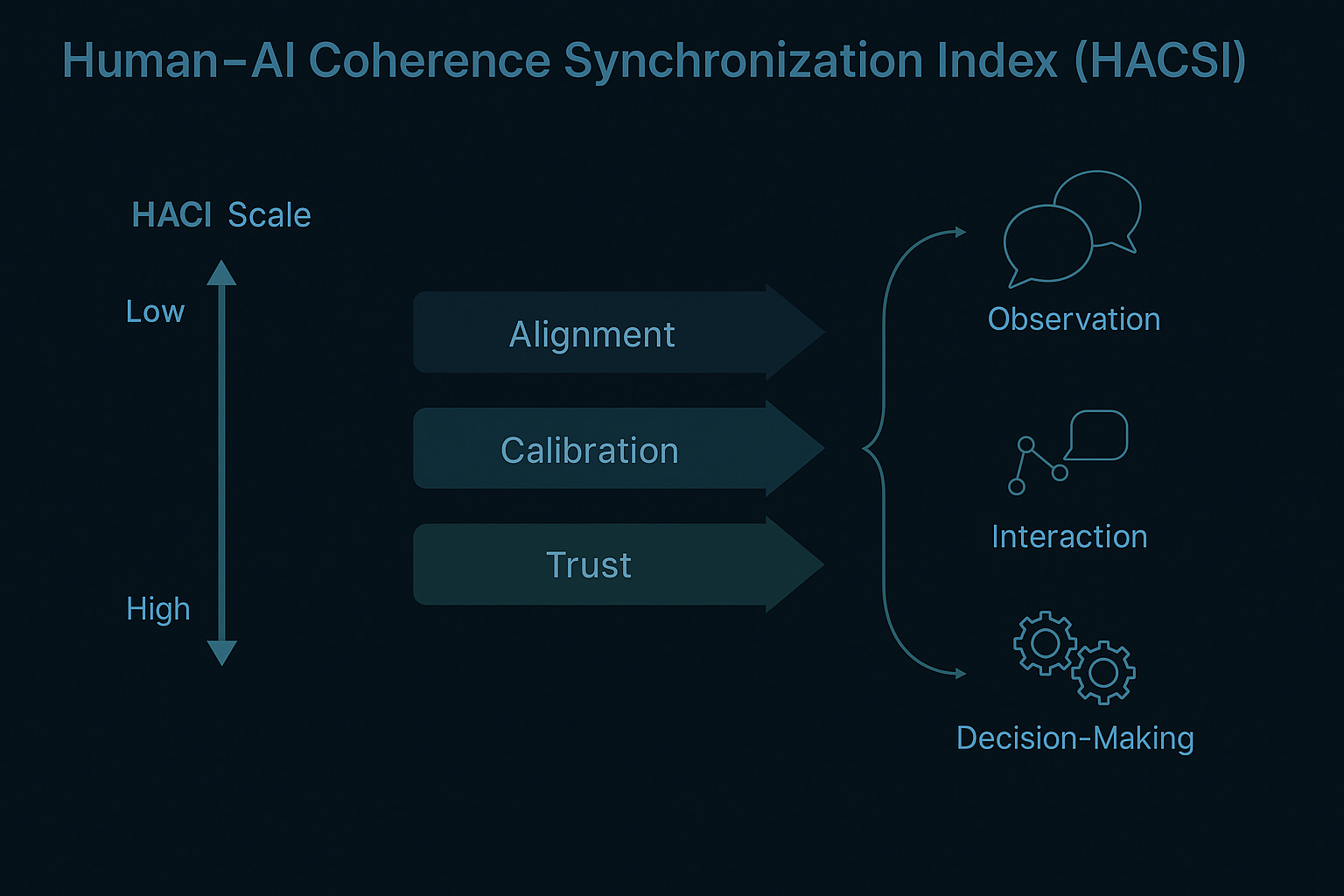
We keep asking the wrong question about human–AI teaming:
“Is the model accurate?”
Accuracy matters.
But it’s not what breaks missions.
What breaks missions is when humans and machines
stop seeing the same world.
That’s a coherence problem.
So I built the Human–AI Coherence Synchronization Index (HACSI).
HACSI doesn’t care how shiny the model is.
It measures one thing:
How closely the human’s interpretation of the battlespace
matches the AI’s interpretation over time.
On the HACSI map, you plot two scores:
- AI coherence
- human coherence
When they move together in a narrow band, you have synchronized clarity.
When they split, you get three dangerous zones:
• Over-Trust – AI looks coherent while the human is cognitively overloaded
• Human Override – human is stable but fighting a drifting system
• Global Confusion – both are degraded and nobody realizes it yet
This is the piece missing from most “human–machine teaming” discussions.
We don’t just need better models.
We need a way to see, in real time, when the human and the machine
have quietly stopped agreeing on what’s true.
HACSI is a way to make that visible.
Because if interpretation is the new center of gravity,
then human–AI coherence is no longer a soft topic.
It’s a survivability metric.