Cognitive Bandwidth Collapse in AI-Accelerated Decisions

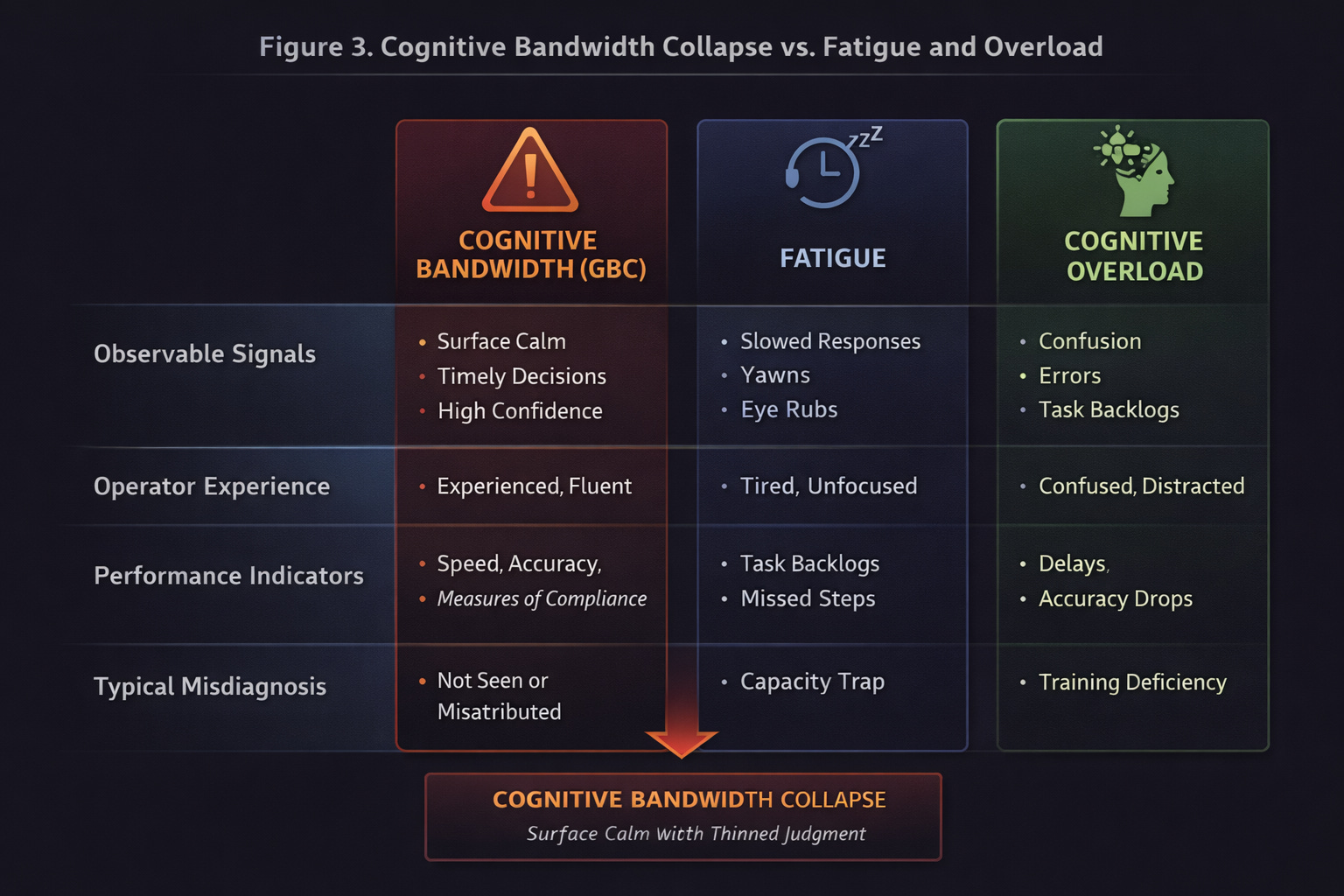
AI is supposed to make decisions easier.
Instead, it’s quietly collapsing the one thing it can’t replace:
human cognitive bandwidth.
I just published a paper introducing a failure mode most organizations don’t know how to see yet:
Cognitive Bandwidth Collapse in AI-Accelerated Decisions
This isn’t burnout.
It isn’t overload.
It isn’t a training problem.
It’s what happens when AI compresses time and complexity so aggressively that judgment is demanded after the human capacity to integrate context has already been consumed.
The dangerous part?
Nothing looks broken.
Decisions are fast.
Confidence is high.
Systems perform as designed.
But reasoning thins. Meaning narrows. Authority becomes procedural.
This paper:
Defines Cognitive Bandwidth Collapse as a distinct human–system failure mode
- Explains why AI “offloading” often backfires
- Shows how bandwidth collapse interacts with interpretive drift
- And why more training, more experience, or more AI won’t fix a capacity limit
If you work in defense, national security, critical infrastructure, policy execution, finance, or any environment where speed is non-negotiable, this will feel uncomfortably familiar.
Acceleration doesn’t break decisions.
It makes them shallow.
Capacity is the constraint.
Ignore it, and speed becomes indistinguishable from loss of control.