Before the Decision, Something Breaks

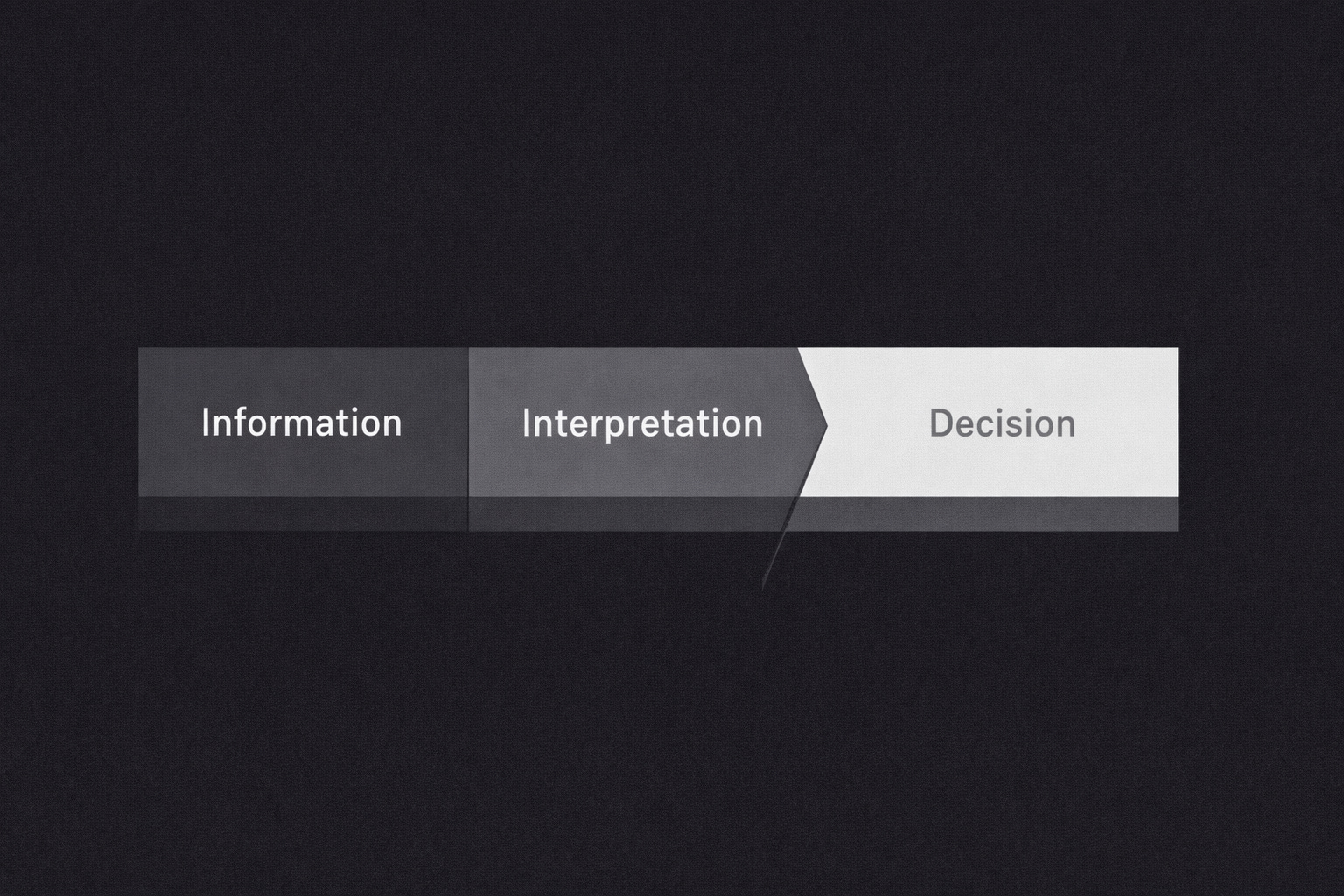
Most failures don’t announce themselves as failures.
They arrive dressed as alignment.
Consensus.
Clear dashboards.
A room nodding at the same slide.
Everyone agrees.
And later, everyone swears they understood something different.
This is the part we tend to skip over when we do after-action reviews. We audit the outcome. We interrogate the data. We debate execution.
But the fracture usually happened earlier.
Scene One: The Perfect Brief
The operating picture is clean.
The data is current.
Every system involved did exactly what it was designed to do.
The briefing moves fast — efficient, professional, confident. No one objects. No one slows it down. The decision is made with conviction.
Weeks later, when the consequences surface, the question becomes: How did we miss this?
The uncomfortable truth is that nothing was “missed.”
The same information was present in the room.
What differed was how it was interpreted — quietly, individually, and without being surfaced.
At what moment did command actually break?
Scene Two: Agreement Without Alignment
You’ve seen this one.
The meeting ends with verbal agreement. Action items are assigned. Everyone leaves believing they’re aligned.
Then execution begins.
Suddenly, small mismatches appear:
Different assumptions about priority.
Different interpretations of risk.
Different understandings of what “success” actually looks like.
No one is being disingenuous. No one is incompetent. Everyone believes they’re executing the plan.
They’re not.
They’re executing their version of it.
When did agreement stop meaning alignment?
Scene Three: The Uneasy Silence
This is the hardest one to name.
A system delivers insight — fast, precise, confident.
The output is persuasive. The recommendation feels solid.
And yet… something feels off.
No one can point to an error.
No metric is violated.
There’s no obvious fault to challenge.
So the feeling is suppressed.
Later, when the decision proves wrong, someone will finally say, “I had a bad feeling about that.”
They did.
They just didn’t have language for it at the time.
Who noticed — and who didn’t?
What We Tend to Get Wrong
We like to believe that breakdowns occur at the point of action:
A bad call.
A delayed response.
A technical malfunction.
But many failures originate before any of that — in the interpretive layer where meaning is assigned, not measured.
By the time a decision looks “wrong,” it’s often already been internally justified multiple times over.
A flawless operating picture paired with a bad frame doesn’t look dangerous.
It looks decisive.
That’s what makes it so hard to catch.
Why This Keeps Repeating
Organizations are very good at managing information.
They are less good at noticing when meaning quietly diverges.
We don’t routinely ask:
Are we interpreting this the same way?
Are we using the same frame?
Are we assuming the same constraints?
Those questions feel subjective. Slippery. Hard to operationalize.
So they’re skipped.
And when interpretation drifts without being surfaced, command doesn’t erode loudly.
It fractures silently.
The Hard Part
Once you start noticing this, it becomes difficult to unsee.
You begin to recognize the moments where confidence outpaces coherence.
Where speed replaces shared understanding.
Where silence is mistaken for agreement.
None of this is malicious.
None of it requires bad actors.
It emerges naturally in complex, high-tempo environments — especially ones increasingly mediated by automated systems that optimize for clarity, not shared meaning.
The challenge isn’t that we lack data.
It’s that we rarely pause to examine how that data is being understood before it’s acted on.
A Quiet Question
Before the next decision.
Before the next briefing.
Before the next confident nod around the table.
Ask yourself:
Are we aligned on the information — or on the meaning we’re assigning to it?
The answer usually determines the outcome long before anyone realizes a decision has been made.
And once you notice that…
You start watching meetings differently.