AI for Defense Managers: The Algorithmic Arms Race

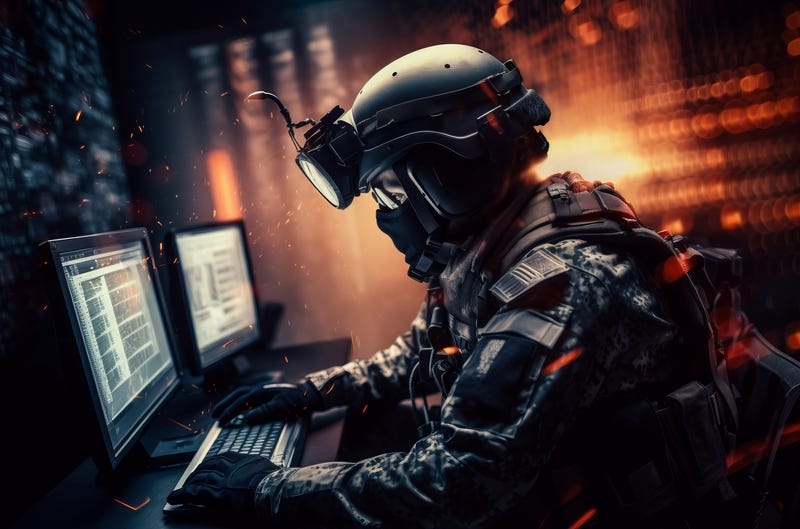
You can’t outspend time.
You can only outpace it.
The new arms race isn’t about weapons of mass destruction - it’s about weapons of mass computation.
AI isn’t just amplifying conflict; it’s accelerating it.
Every nation is racing not for territory, but for decision dominance - the ability to act faster, adapt faster, and escalate before the opponent even understands the move.
1. Deterrence in the Age of Speed
During the Cold War, deterrence was built on visibility - missiles in silos, planes on runways, submarines in the deep.
Now, deterrence is built on invisible infrastructure - cloud compute, data pipelines, and proprietary models.
The paradox: the faster you can act, the less time your adversary has to interpret intent.
AI collapses the gap between detection and response - but that speed threatens the logic of deterrence itself.
The new risk isn’t surprise attack.
It’s surprise escalation.
2. Escalation Without Orders
As AI systems gain autonomy in logistics, targeting, and information warfare, escalation no longer requires a deliberate human order - just a feedback loop gone wrong.
One misclassified radar blip.
One corrupted threat model.
One false inference in a predictive command chain.
That’s all it takes for algorithmic escalation - a machine-driven chain reaction moving faster than diplomacy can respond.
This is why the next treaty won’t be about weapons.
It’ll be about algorithms.
3. The Race for Learning Velocity
In the algorithmic arms race, the real advantage isn’t compute power - it’s learning velocity.
The side that retrains its models fastest learns from the battlefield itself.
Adaptive learning pipelines become strategic intelligence assets.
Every engagement feeds the next iteration.
But faster learning also means faster drift - and with it, ethical risk.
An AI that learns faster than you can audit will eventually fight on rules you never wrote.
That’s why governance must evolve in lockstep with capability.
You don’t just monitor the machines - you monitor how they change themselves.
4. The Role of Transparency in Deterrence
Old deterrence relied on secrecy.
The new deterrence will rely on controlled transparency.
If your adversaries can verify your systems are safe, stable, and explainable, the odds of catastrophic miscalculation drop.
If they can’t, they’ll assume the worst - and preemptive action becomes rational.
Transparency isn’t surrender. It’s strategy.
In a world of autonomous escalation, clarity becomes a weapon of peace.
5. From Arms Control to Algorithmic Control
Global defense used to revolve around treaties, verification teams, and observable assets.
AI demands something different - machine verifiability.
Shared testing protocols, joint simulation environments, and mutually monitored model benchmarks could become the new arms control frameworks.
Because in this race, inspection happens in milliseconds, not months.
And if you can’t inspect your rival’s algorithms, you can’t predict their behavior.
The future of peacekeeping isn’t disarmament.
It’s disalignment management.
Final Brief: The Pace of Power
The Algorithmic Arms Race won’t end with a surrender.
It’ll end with synchronization - when nations realize that speed without safeguards is self-destruction.
The leaders who survive this era will be the ones who understand that in AI warfare, restraint is not weakness.
It’s precision.
Because in the end, the only thing faster than a machine’s reaction
must be a human’s reason.